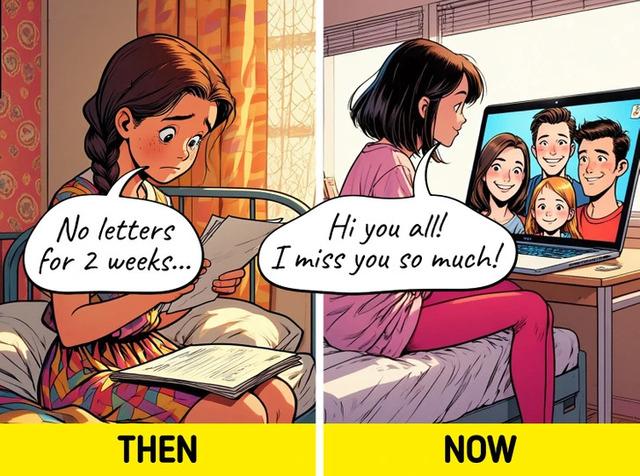
Time doesn’t stand still—and neither do we. What once seemed completely normal 40 or 50 years ago might now leave us scratching heads in disbelief. How we think, communicate, fall in love, and even perform the most mundane household chores has undergone a radical transformation. This shift isn’t necessarily a descent into chaos or a rise into utopia; it’s simply the fluid nature of human existence.
To capture this whirlwind of change, a series of 18 clever comics, brought to life with the assistance of AI-generated art, offers a window into our collective soul. They don’t judge the simplicity of the past or glorify the high-tech sheen of the present. Instead, they serve as a mirror, reflecting how the small, everyday moments of life have transformed in ways our grandparents could never have imagined.
1. Motherhood Unbound: The Sunset of Social Stigma
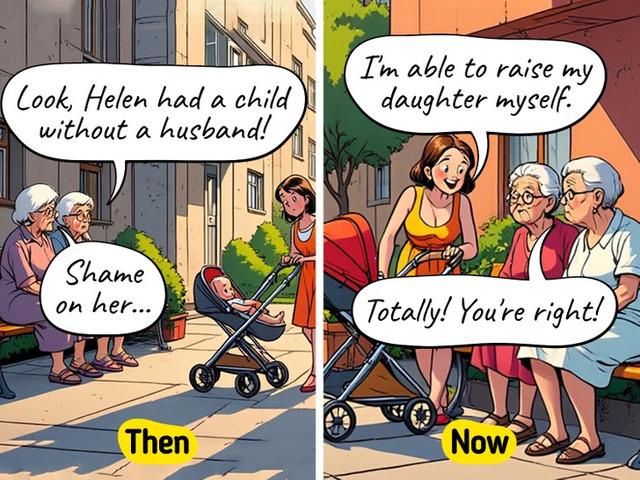
In the mid-20th century, the “unmarried mother” was often a figure of hushed whispers and social isolation. The “Then” panel of our first comic depicts a woman walking with her head down, avoiding the judgmental glares of a judgmental neighborhood. Fast forward to the “Now” panel, and the scene is entirely different. Today, society has largely embraced the autonomy of women. A single mother is no longer defined by her marital status but by her strength, career, and the love she provides. Personal life is finally just that—personal.
Stay connected is easier and faster than ever. See how the tools that bridge our worlds have evolved over the decades.
2. The Death of the Artisan: From Hand-Carved to “Add to Cart”
There was a time when “DIY” wasn’t a trendy YouTube category; it was a survival skill. We made our own clothes, repaired our own furniture, and carved toys from wood. The comic illustrates a grandfather meticulously sanding a stool, contrasted with a modern young adult clicking a button on a smartphone. While we’ve gained immense convenience and reclaimed thousands of hours of free time, there’s a subtle nostalgia for the “soul” found in objects made by hand.
3. Reverse Mentorship: When Toddlers Become Tech Support
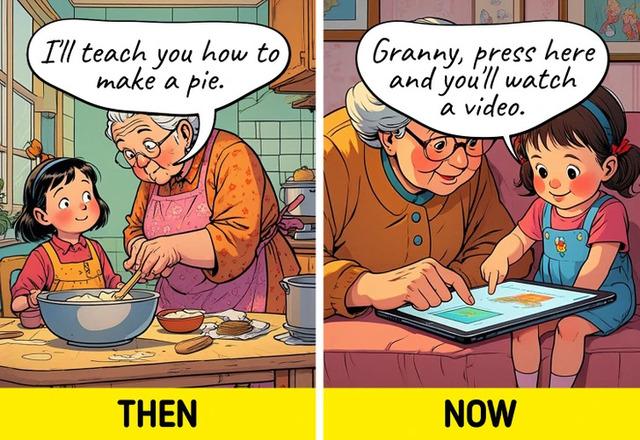
Perhaps the funniest role reversal of the modern era is the direction in which wisdom flows. Traditionally, the elder was the gatekeeper of knowledge. Today? The comic shows a gray-haired grandfather staring at a tablet as if it were an alien artifact, while a three-year-old in a diaper calmly swipes to find the “Settings” menu. We have entered an era where the youngest among us are the native speakers of the world’s most important language: Digital.
4. Blurred Lines: The Normalization of Platonic Co-existence
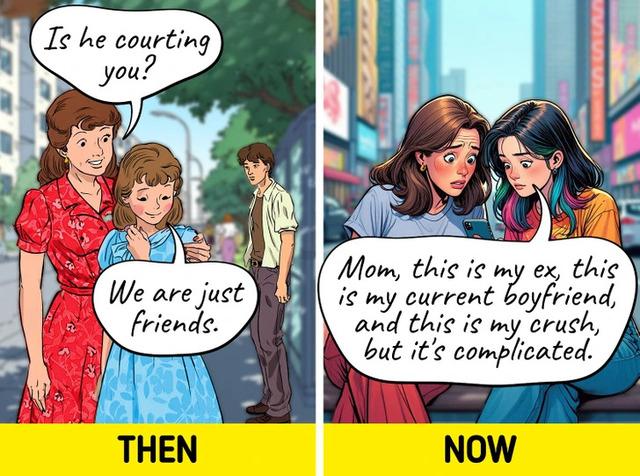
Friendship between a man and a woman used to be a social enigma, often viewed with suspicion or the assumption of a hidden romance. Modern social openness has shattered this “Hush-Hush” era. The comic highlights this shift beautifully: in the past, a man and woman dining together meant an engagement was imminent. Now, it simply means two friends are splitting an appetizer before heading to their respective homes. Shame has been replaced by freedom.
5. The Silent Supper: Romance in the Age of Blue Light
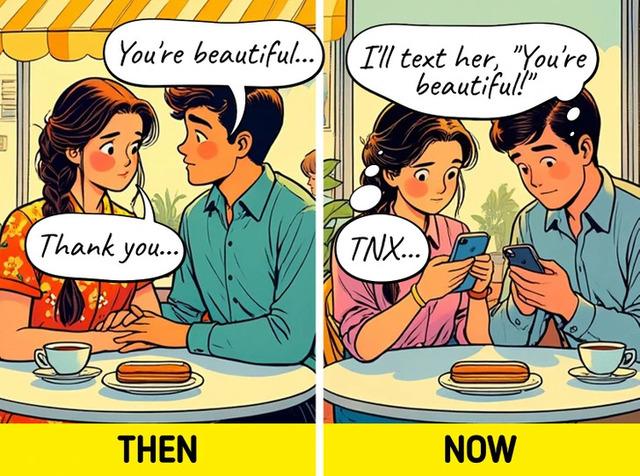
Dating once required the terrifying art of face-to-face conversation. You had to look into someone’s eyes and navigate the silence. Today’s comic depicts a “romantic” dinner where both parties are bathed in the blue glow of their screens, texting each other from across the table. It’s a humorous, if slightly stinging, reflection of how digital intimacy has sometimes replaced physical presence.
6. The Casual Introduction: Pajamas and Potential In-Laws
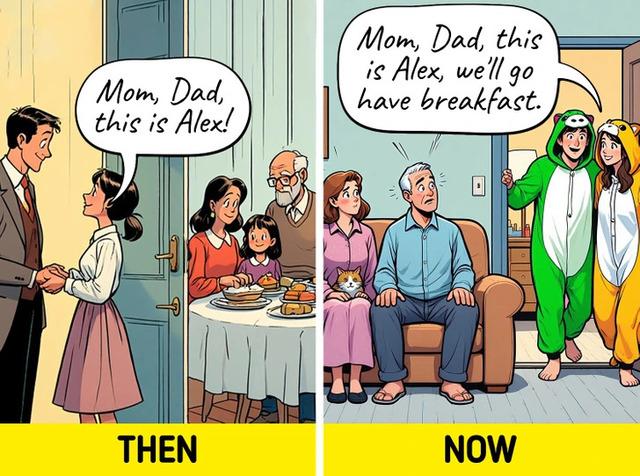
“Meeting the parents” used to be a high-stakes, formal ritual involving Sunday best and a polite interrogation over tea. Modern life has stripped away the ceremony. The comic shows a partner stumbling into the kitchen in messy hair and pajamas, only to find the “potential in-laws” already making coffee. No drama, no fainting—just a casual, “Morning, Greg,” as the barriers of formality continue to crumble.
7. The Global Village: Love at the Speed of Fiber Optics
Contrasting the agonizing wait for an airmail letter—which could take weeks to cross the ocean—with today’s reality is staggering. The comic illustrates the joy of a grandmother in Seoul seeing her grandson in New York via a video call. This isn’t just about speed; it’s about the erosion of distance. We are more connected than ever, and this is one area where the “Now” feels undeniably like a miracle.
8. The High-Tech Hearth: Robot Vacuums vs. Mom’s Magic
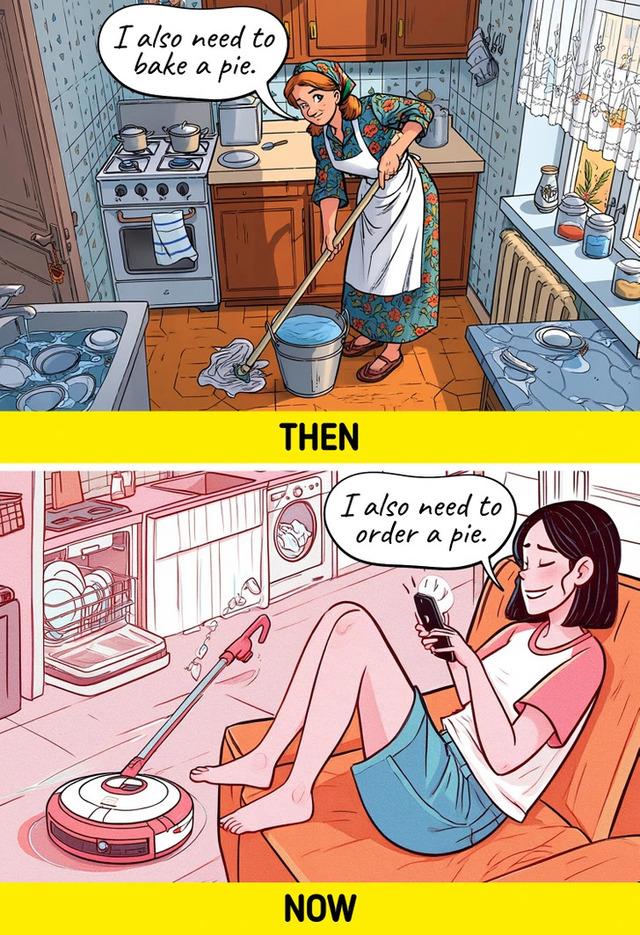
We live in an age of domestic automation. We have robot vacuums that navigate our rugs and dishwashers that think for themselves. The comic shows a sleek, automated kitchen that looks like a spaceship. However, the punchline remains: despite all the high-tech gadgets, nothing can replicate the flavor of a meal cooked by a mother’s hands. Science has conquered the “cleaning,” but it hasn’t yet mastered the “soul” of home cooking.
9. Extended Adolescence: 25 is the New 15
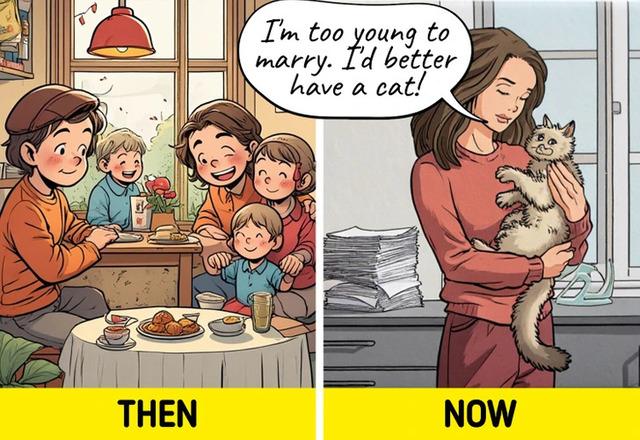
The timeline of adulthood has shifted dramatically. In the “Then” panel, a 25-year-old is depicted as a homeowner with a mortgage and three children. In the “Now” panel, the 25-year-old is shown having a nervous breakdown because they can’t decide if they are “mature enough” to take care of a succulent. Priorities have shifted toward self-discovery and education, moving the “start” of adulthood further down the road.
10. The Sweatpant Professional: The Legitimacy of Remote Work
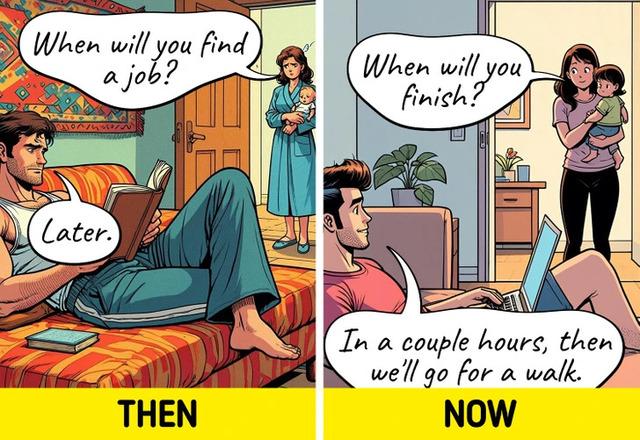
Forty years ago, if you stayed home during work hours, the neighbors assumed you were unemployed or ill. Today, as the comic illustrates, the person in the hoodie and sweatpants on the couch is likely a high-level executive or a creative powerhouse crushing a global deadline. Remote work has moved from a sign of “laziness” to a badge of modern corporate flexibility and digital mastery.
11. The Living Room Cinema: The Quiet Death of the Box Office
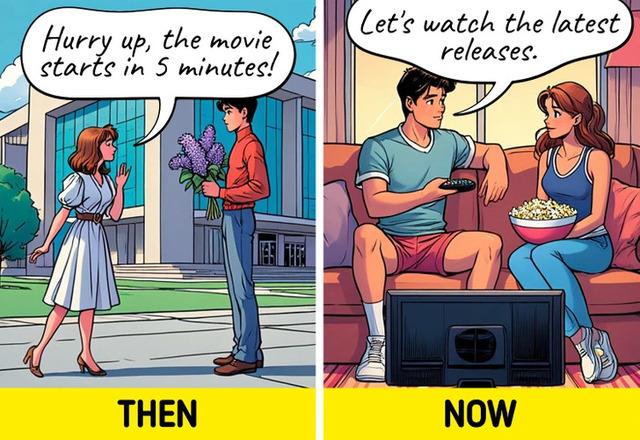
Who needs a crowded theater with sticky floors? The comic hilariously portrays the evolution of “Movie Night.” What used to be an expensive trek to the cinema is now a “snack-and-slipper” marathon on the sofa. Streaming platforms have turned every living room into a private theater, prioritizing comfort and the “Pause” button over the grandeur of the silver screen.
12. The Digital Guillotine: Breakups in the Block-Button Era
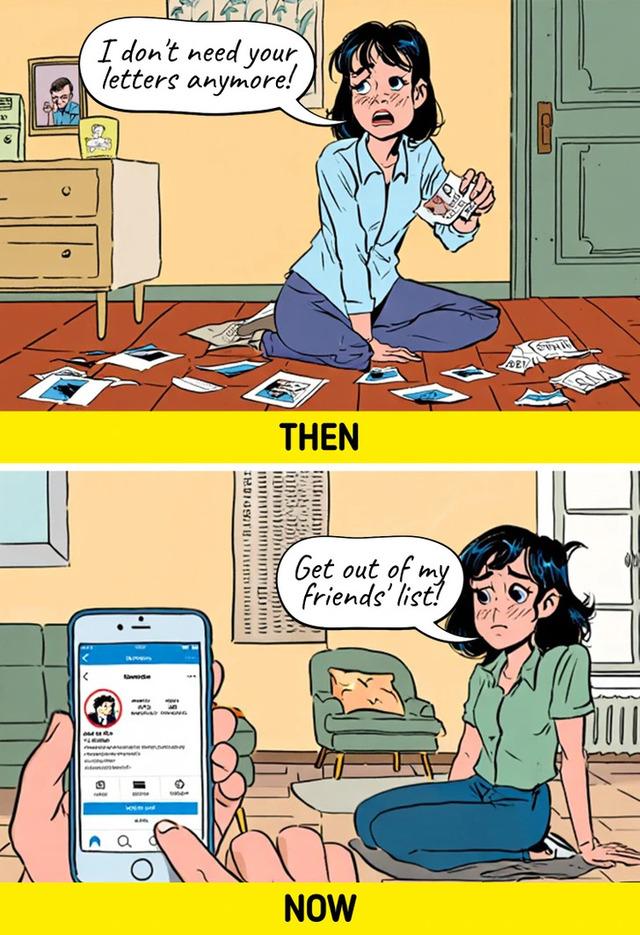
Breakups in the past involved the physical ritual of tearing up letters or burning old photographs in a shoebox. Today, the closure is clinical and digital. One click of the “Block” or “Unfollow” button, and a person is effectively erased from your universe. The comic highlights this transition with a touch of irony—closure is faster now, but perhaps less cathartic than the old-fashioned bonfire.
13. The Virtual Fitting Room: Shopping Without the Changing Room
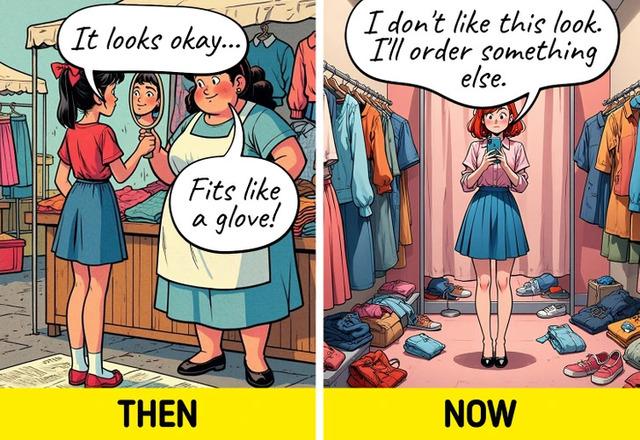
The awkward fluorescent lighting and cramped spaces of the mall changing room are becoming relics of the past. The modern comic shows the living room as the new “fitting room,” where the floor is covered in delivery boxes. We try, we decide, and we send back. It’s a shift from the social experience of “going shopping” to the private convenience of “having it delivered.”
14. Logistics as a Superpower: The Doorstep Delivery Revolution
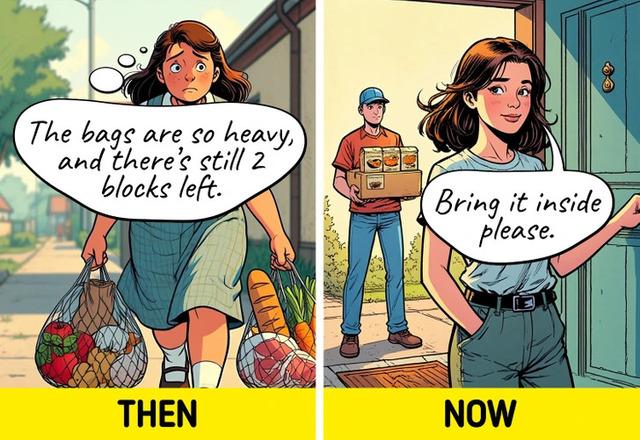
Our ancestors had to hunt, gather, or at least walk to the local market. Today, we have the superpower of delivery. Groceries, medicine, and even a single hot latte can arrive at our door in under thirty minutes. The comic depicts the modern consumer as a king on a throne, with a fleet of couriers bringing the world’s bounty to their doorstep.
From the way we shop to the way we eat, the logistics revolution has transformed the pace of our daily lives.
15. The Surveillance Safety Net: Parenting in the GPS Age
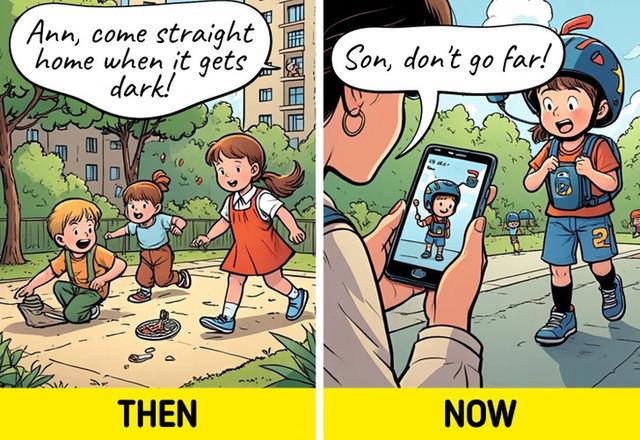
In the 1970s, parenting advice often boiled down to: “Be home when the streetlights come on.” Today, as the comic shows, kids are equipped with GPS smartwatches and security cameras that allow parents to monitor their heart rate and location in real-time. The meaning of “safety” has moved from “trusting the neighborhood” to “trusting the technology.”
16. The Image Overload: From One Roll of Film to 10,000 Selfies
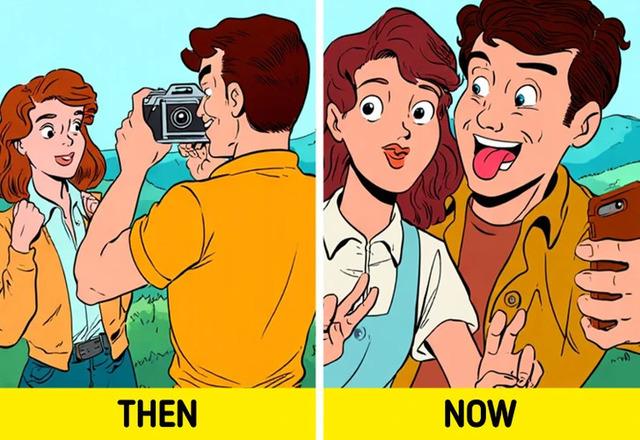
We used to treat photography with a sense of reverence. A 24-exposure roll of film had to last an entire vacation. The comic contrasts a family carefully posing for a single holiday photo with a modern teenager taking 400 selfies just to find the “right angle” for a Tuesday afternoon post. We have moved from capturing memories to documenting existence.
17. Connected but Alone: The New Family Dynamic
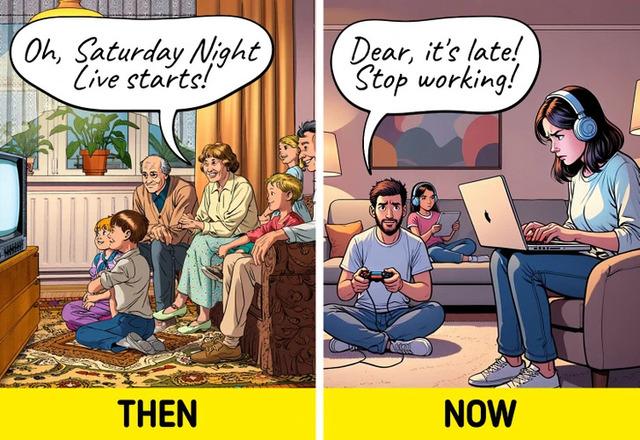
The “Then” panel shows a family gathered around a single TV set, forced to watch the same program. The “Now” panel shows four people on the same couch, but each is in their own digital silo—one on a laptop, one on a console, two on phones. We are physically together but mentally separated by our personal algorithms. It is not necessarily a bad thing, but it is a distinct shift toward individualism.
18. The Constant Constant: Why Cats are Immune to Progress
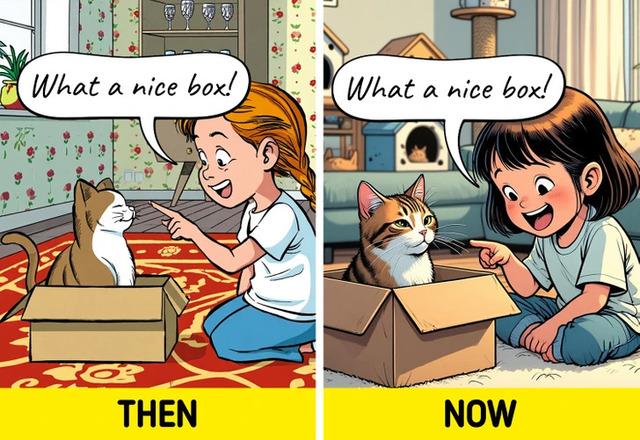
If there is one thing that has remained utterly unchanged by the digital revolution, it is the attitude of the domestic cat. The final comic in the series shows a cat sitting on a 1950s radio and a cat sitting on a 2024 high-end gaming laptop. In both cases, the cat looks equally bored and superior. Humans may change their tools, their clothes, and their politics, but the cat remains the sassy, lazy master of the house.
Final Thoughts: Embracing the Flux
These 18 comics aren’t just a series of jokes; they are a sociological study of our collective adaptation. As we look at these panels, we see our own lives reflected back at us—the joys of convenience, the stings of digital isolation, and the humor found in the absurdity of our new habits.
Change is the only true constant in the human story. Some things, like the way we communicate across oceans, have improved beyond measure. Others, like the way we focus on our dinners, have perhaps lost a bit of their luster. But at the heart of every comic is a reminder that we are a resilient, evolving species. Whether you miss the days of handwritten letters or you can’t imagine living without your robot vacuum, one thing is certain: the world will continue to change, and we will continue to find the humor in it.
As we move toward the next fifty years, one can only wonder: what will the comics of 2075 look like when they look back at us? Perhaps they’ll laugh at our “primitive” smartphones and our “quaint” practice of typing on keyboards. But as long as there are cats and home-cooked meals, we’ll probably be just fine.